
On Playpens, Independent Play, and the Permission to Step Away
This post contains affiliate links. I only recommend products I have personally used or thoroughly researched, and I’ll always tell you which is which. 💕
The playpens I trust after researching every type, from mesh to wooden, for the safety and the sanity of overwhelmed parents.
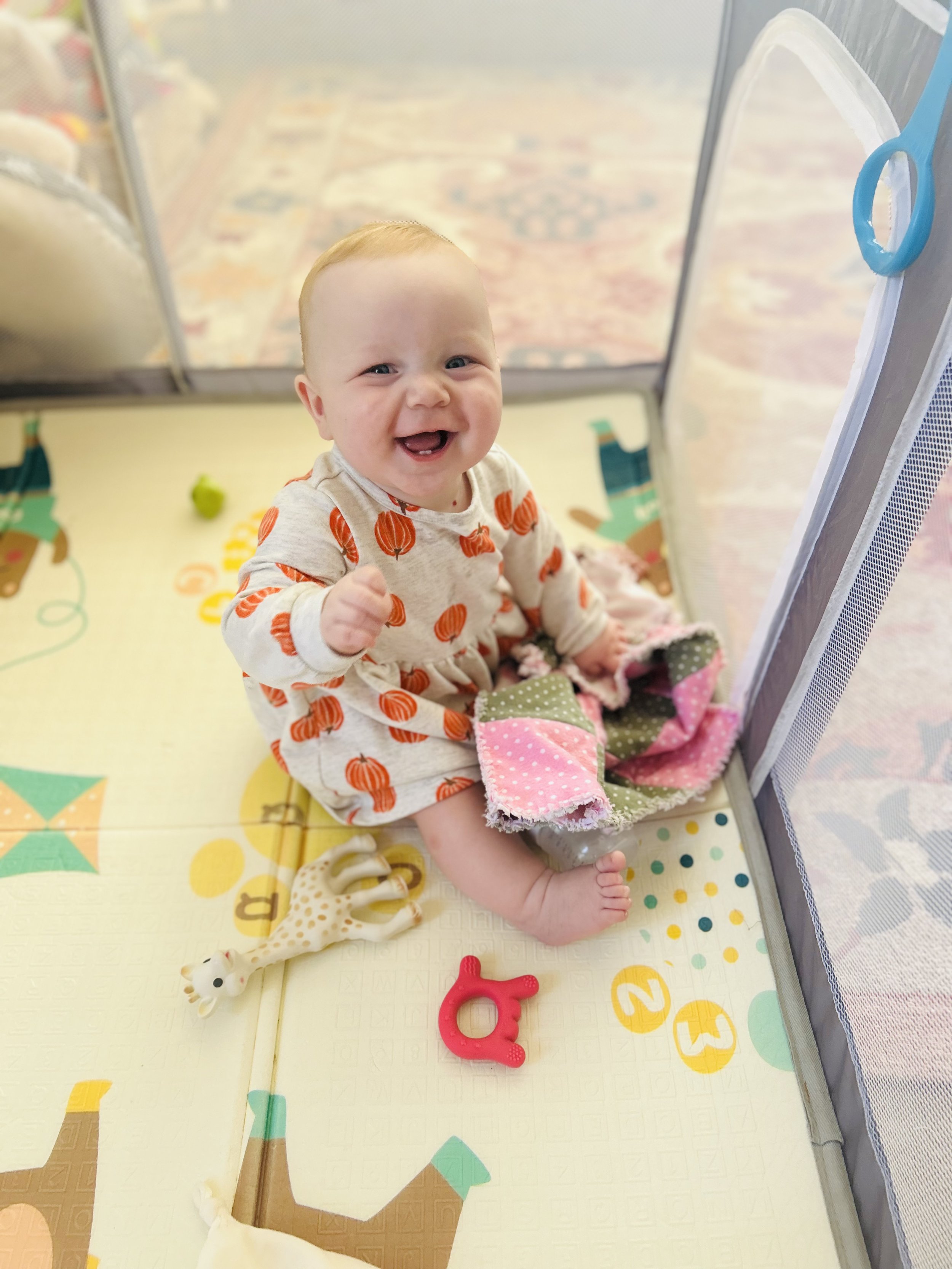
For some reason, I was under the impression that playpens were a thing of the past, relics of the eighties and nineties that had gone out of existence because we finally “knew better” about safety. But when Rosie turned five months old, a friend bestowed upon us her daughter’s old playpen.
Just a 50x50 square of mesh and plastic, but it was the first space where her independence could safely take root. A gateway to her autonomy. And mine, too. And yes, I do believe a playpen deserves such reverence, because it brought a profound shift in our freedom and peace.
Motherhood in those early months is a constant state of hyper-vigilance; you cannot separate your body from their safety.
The playpen changed the geography of our days. For her, it was a safe and predictable perimeter where she learned to navigate her own boredom and invent her own play. For me, it was simpler and more urgent. It was the only way I could make a cup of coffee, use the bathroom in solitude, or breathe for two minutes when the maternal world became too loud to bear. It wasn’t a cage; it was the first place we learned to exist happily apart, giving her a space to become an independent creature and giving me back the basic mechanics of being a person.
Now we own three, and I have tested every one against the only standards that matter.
Her safety.
My sanity.
So you don’t have to.
✦ ✦ ✦
What Actually Makes a Playpen Safe
Here’s where the research nerd in me takes over, because “it has four sides and a floor” is not a safety standard. A few things actually matter, and they’re easy to check before you buy.
The mesh is the first one. If the sides are mesh, the holes should be small, no bigger than a quarter inch, so little fingers and the buttons on a onesie can’t get caught. Run your hand along it and make sure it’s pulled taut and securely attached, with no loose spots or tears.
After that, look for sides at least 20 inches tall measured from the floor of the pen, a firm pad at the bottom instead of anything soft or pillowy, and a lock or outside zipper you can work easily but your baby can’t. If you want a shortcut, check the label for JPMA certification, which means the playpen was tested against the federal safety standards, so you’re not taking a stranger’s word for it. And a side note: skip the ones with the big diamond-shaped openings. Those older accordion-style pens are exactly the kind a baby’s head can get caught in.
None of this takes long. It’s the difference between a safe space and a thing that looks like one.
And if this kind of deep dive speaks your nerd language too, it’s the same homework I did on the rear-facing car seat limitsno one tells you about.
The second thing is pen positioning, where it actually sits. It’s the easiest one to forget, because a playpen moves about your home where it’s needed. It gets shuffled for vacuuming, folded away for company, wedged into a corner, and every new spot means recalibrating your danger zone.
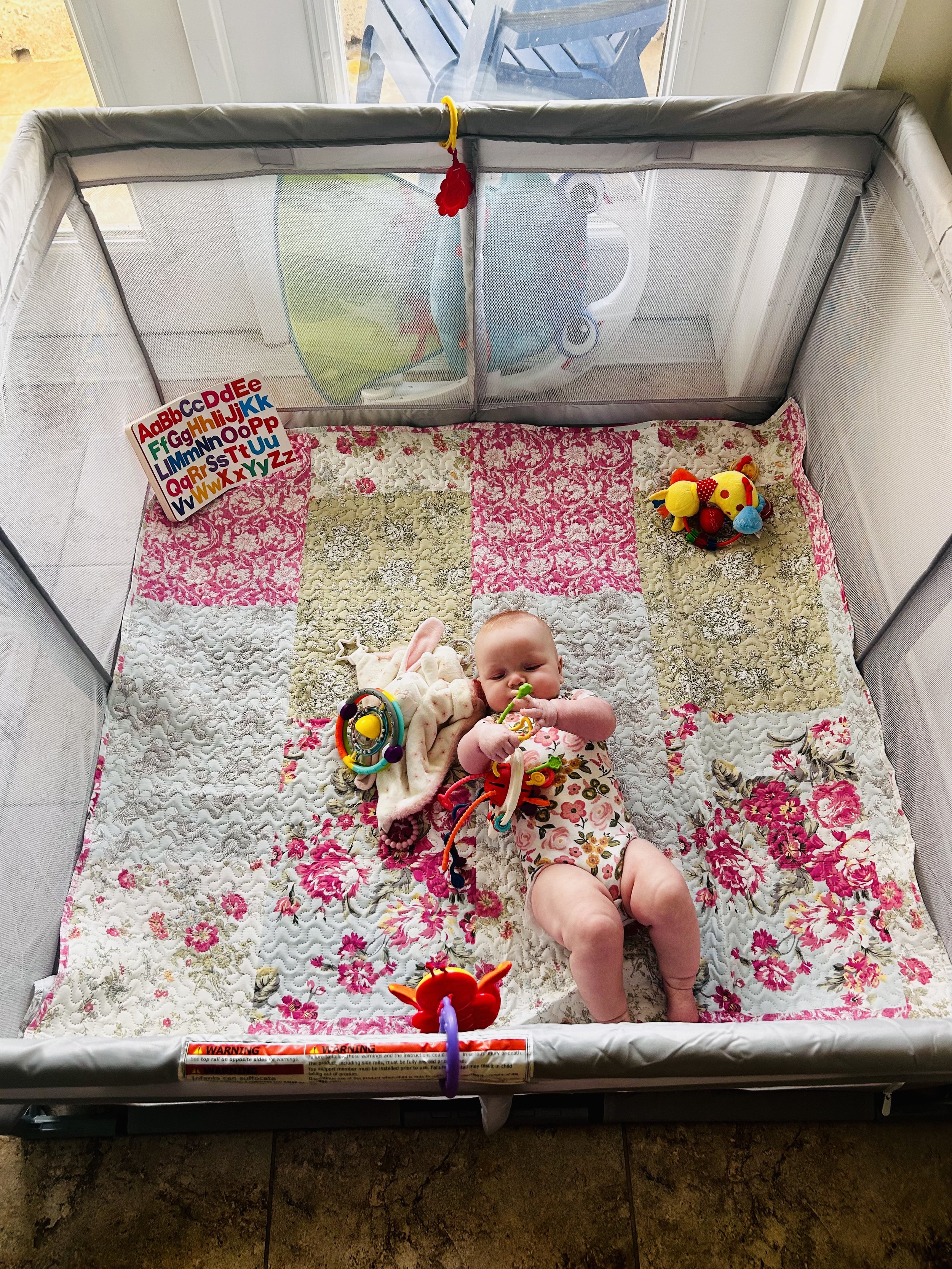
The non-negotiable: never near a window, because the cords on blinds and drapes are a strangulation risk, and that’s the one I’d write in permanent marker if I could. Then look at what sits within arm’s reach of the sides, because babies pull things in sooner than you’d think, and once they can stand, anything pushed up against the pen becomes a step stool.
Learn from my mistakes. I’ll confess my own recalibration situation. Rosie’s collapsible playpen lives in my bedroom, which is generously sized, but it is not a living area, which means the pen fits beautifully and is also closely bordered by my domestic abundance. Somewhere, right now, Mama Reder’s eyes are rolling at that euphemism.
On one particular day, the danger zone I forgot to account for was my vanity, which put my curling iron, a porcelain trinket dish of stud earrings, my Tom Ford perfume that I had been rationing for two and a half years, and a CZ tennis bracelet all within striking distance. Not to mention an abundance of lotions, potions, and retinols.
Needless to say, a baby hazard buffet. So now I do one thing every time the pen moves. Walk the perimeter once.
What can she reach?
What can she pull?
What could she climb?
✦ ✦ ✦
A Quick Word on “Leaving Them Alone”
Sometimes the point isn’t development at all. Sometimes you just need to answer the door, or take something off the stove, or go to the bathroom without a baby toddling toward that tiny breakable family heirloom. A playpen means they are safely contained for that minute. And that is not something you should feel guilty about. That is something you should feel good about. Ensuring that they are safe.
Contained is not caged. Contained is just safe.
A spot you chose, while you do the things you have to do and they do the things they love.
There’s a guilt that creeps in when you put your baby in a playpen and walk even three feet away. It feels like abandonment. It isn’t. What it actually is, is one of the oldest ideas in child development: uninterrupted play.
Magda Gerber, who founded the RIE approach to infant care, spent her career teaching parents that a baby left to follow their own curiosity, safe, supervised, undirected, is not a baby being neglected. It’s a baby working.
The psychologist Jean Piaget, someone whose ideas I spent a lot of time with while getting my psychology degree and teacher certification, put it more bluntly: whenever we teach a child something, we rob her of the chance to discover it herself.
A playpen, used well, is just a safe place for that discovery to happen. It’s where attention span gets built, because no one is interrupting the thread they’re following. It’s where problem-solving begins, because they’re figuring out their own small world instead of waiting to be entertained. You don’t have to narrate it. You don’t even have to praise it. You just have to let it happen, a few feet away, while you remember you’re a person.
That’s not neglect. That’s the work, and you’re letting them do it.
✦ ✦ ✦
The Playpens I Trust
| Playpen | Price | Key Features | My Take |
|---|---|---|---|
| Best Value Jaobeem Standard mesh | Price$ | Key FeaturesComes with a thick waterproof mat. 360° mesh visibility. Tool-free setup in about 10 minutes. | My TakeThe everyday one I’d point you to. The included mat is the quiet win. Shop Jaobeem → |
| Best for Travel TOREVSIOR Foldable mesh | Price$ | Key FeaturesFolds into a carry bag in seconds. Opens to a full 50x50. External zipper gate. Comes with a mat and ocean balls. | My TakeThe one to reach for when the playpen has to leave the house. Shop TOREVSIOR → |
| Luxe CONKKA Wooden | Price$$$ | Key FeaturesModular 6, 8, or 10 panels. Double-locking door. Folds down for storage, which is rare for wood. | My TakeThe wooden one worth the splurge, and the only wood pick that folds. Shop CONKKA → |
| Luxe for Less HUTOCADA Wooden | Price$$ | Key FeaturesNatural pine, 8 to 10 panels. Doubles as a baby gate. Wall-mount brackets. Tool-free setup. | My TakeThe wood look for less, if the splurge is more than you want to spend. Shop HUTOCADA → |
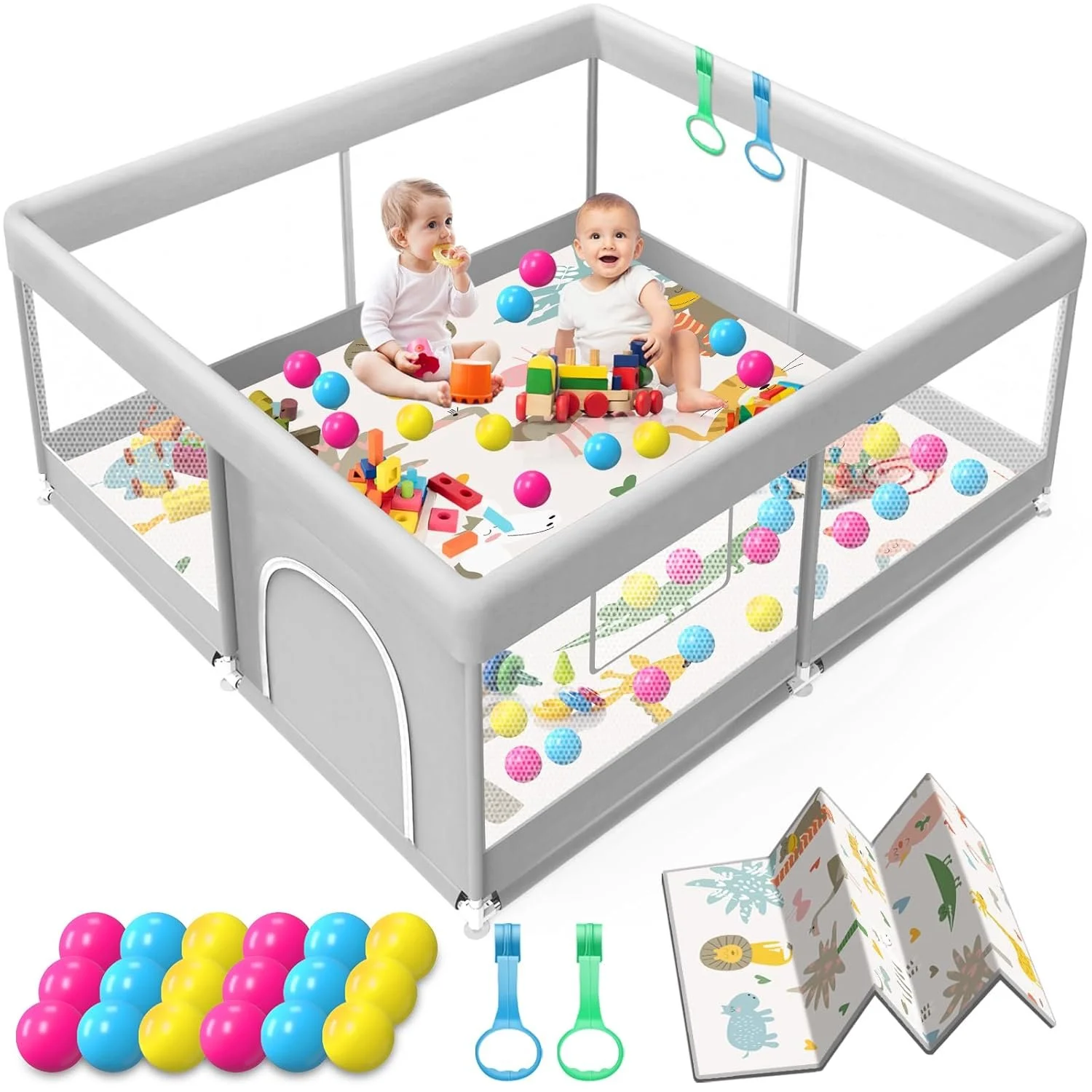
Jaobeem Baby Playpen with Mat: the standard mesh pick
This is the one I’d point you to if you want a straightforward mesh playpen, and the reason is the mat. Most mesh playpens make you buy a mat separately, and you’re going to need one regardless, so a playpen that comes with a durable waterproof mat is doing you a favor. The mesh sides are full 360-degree visibility, which matters more than it sounds like it should: you can see your baby from across the room while you’re doing something else, and they can see you, which is half of why they stay happy in there. It sets up in about ten minutes by one person, no tools, and the suction-cup base keeps it from sliding around once your baby starts pulling up on it. It does one thing and does it well.
Dimensions: 50" x 50"
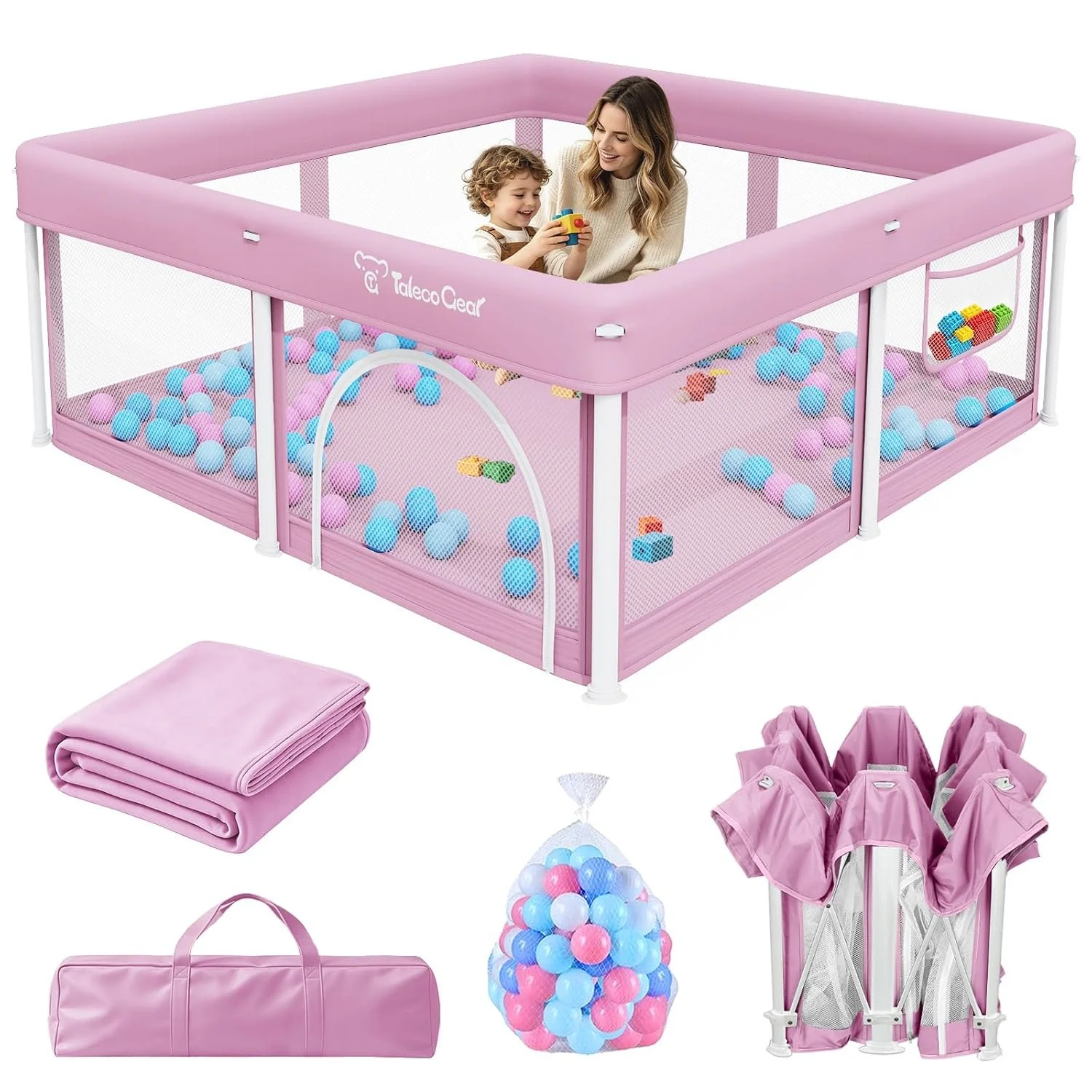
TOREVSIOR Foldable Playpen: the one that travels
This is the one I would buy for you if I could. Maybe someday I'll have my Oprah moment. You get a TOREVSIOR, and you get a TOREVSIOR, and you get a TOREVSIOOOOR! Alright. Couldn't help myself. Back to business. It folds into a carry bag in seconds, which is the whole point: it goes on road trips, to the backyard, to the beach, wherever you need a contained safe spot to practically magically appear. It pops open to a full 50 by 50, so “portable” doesn’t mean cramped, and the gate has an external zipper so your baby can’t figure out how to let themselves out. Like the Jaobeem, it comes with a mat, and this one throws in a set of ocean balls. The mesh is full-view on every side, so you can see them and they can see you whether you’re doing laundry or just trying to sit down for five minutes.
Dimensions: 50" x 50" x 27", folds into a carry bag.
Last month, Rosie stayed with my brother and family while I was at a work conference. When he unloaded her travel playpen at drop-off, he stopped, looked at it, and said, “man, I wish they made these when my boys were little.” That’s the whole review, right there.
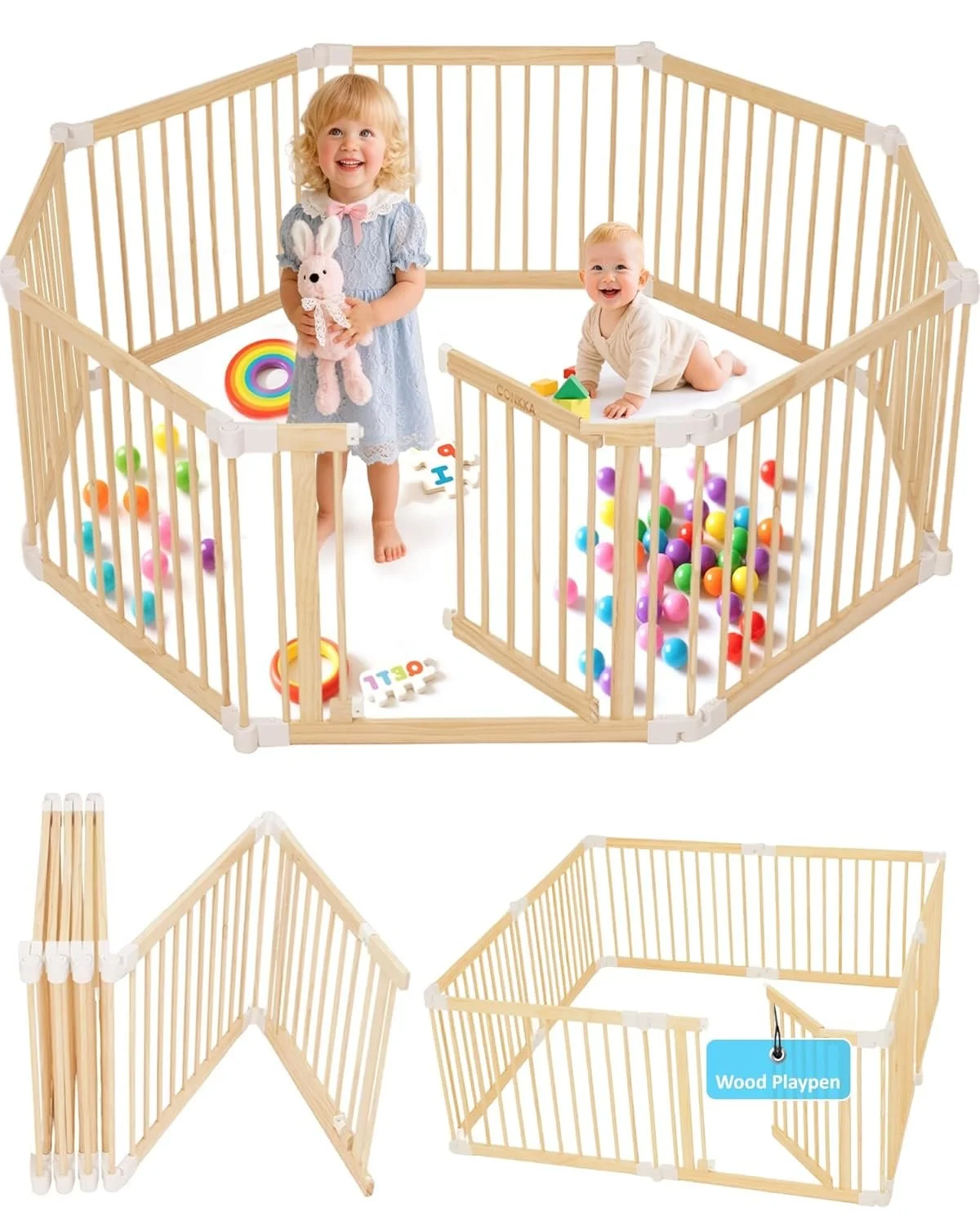
CONKKA Foldable Wooden Playpen: the luxe wooden one worth the splurge
This is the wooden playpen I’d point you to. The panels connect like building blocks, so you can shape it into a small square when your baby is tiny and open it up as they get more mobile. It comes in 6, 8, or 10 panels depending on how much room you want to give them, and the door has a double lock instead of the single-latch gate most wooden pens use. It folds down for storage, which is rare for a wooden playpen, and the modular design means it adapts to your space instead of forcing your space to adapt to it.
Dimensions: modular 6, 8, or 10 panels; roughly 63" square or 74.8" octagon, 25" tall.
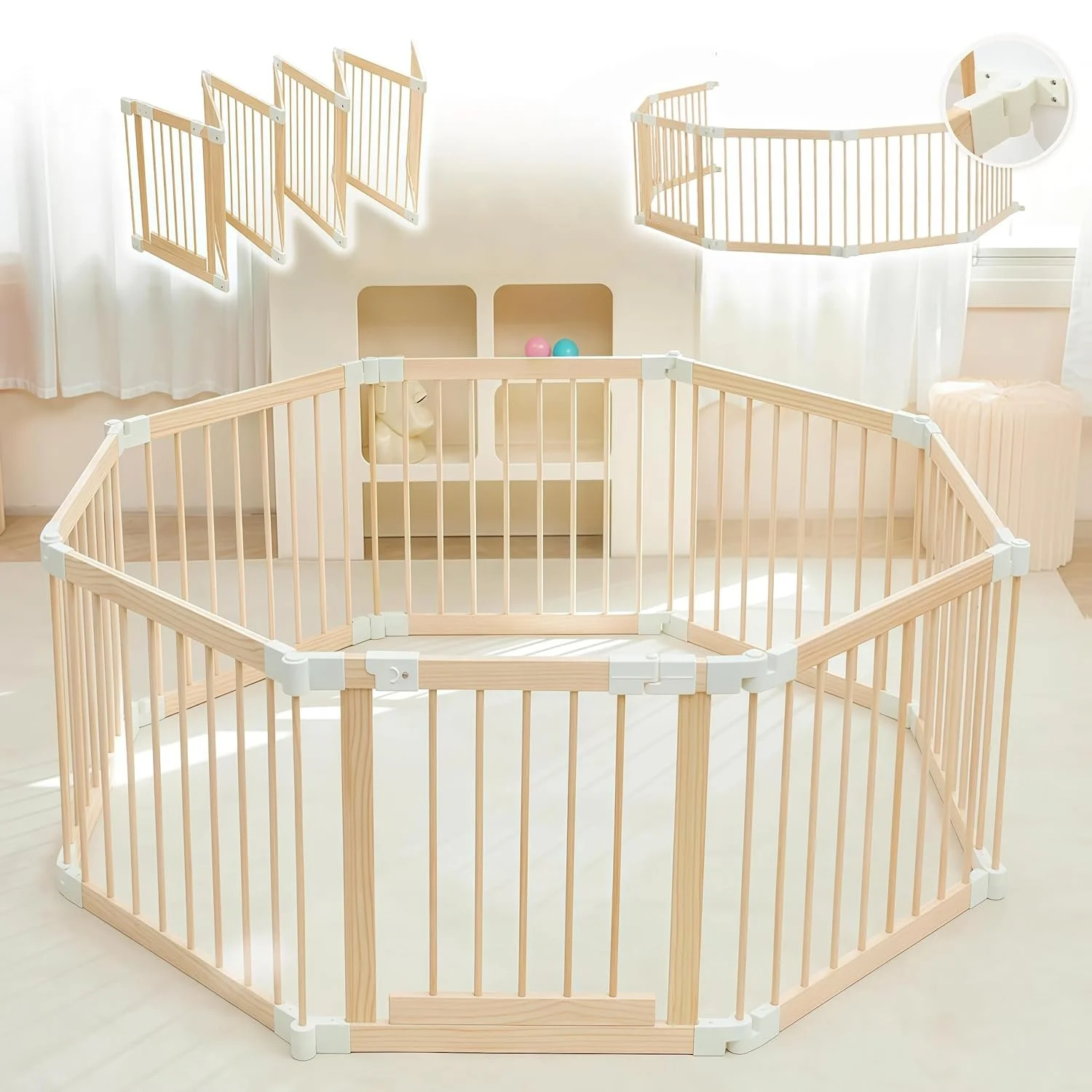
HUTOCADA Wooden Playpen: the luxe for less wooden option
If the wood look is what you’re after but the splurge pick is more than you want to spend, this is the more affordable way in. It’s natural pine, it expands or contracts using 8 to 10 panels depending on your room, and it doubles as a baby gate if you need it to. It folds down for storage and wall-mounts with the included brackets if you want extra stability once your baby starts leaning on it. It sets up tool-free in a few minutes, and the one-hand child lock means you’re not squatting and fumbling every time you step in and out, which you’ll do more than you’d think.
Dimensions: 8 to 10 panels; 56" x 56" x 24", with a larger option.
Want the rest of what actually earned its place in our home? I rounded it all up in baby and toddler essentials guide. Fun fact: the Torevsior playpen was in there originally, but then I decided it deserved a post of its own.
✦ ✦ ✦
Playpen Questions Parents Ask
When can a baby start using a playpen, and when should they stop?
First, yes: playpens are still worth it, and still very much in use. A playpen can be introduced in the early months as a safe, supervised spot, and many families begin once their baby can hold their head up and roll. According to Nemours KidsHealth, you should stop using it once your child can easily climb out, generally when they reach 34 inches tall or 30 pounds. That’s usually somewhere in the toddler stage, and it’s the point where the enclosure becomes a fall risk rather than a safe space.
Are playpens bad for a baby’s development?
Used in moderation, no. A playpen supports healthy independent play, which helps build focus and self-directed exploration. The thing to avoid is overuse: a playpen should never replace floor time, active movement, or one-on-one engagement, and it should never be used as a timeout or punishment.
How long should a baby spend in a playpen each day?
There’s no magic number, and that’s the honest answer: respected pediatric guidance focuses on balance, not a stopwatch. Keep sessions short and supervised, and make sure playpen time is balanced with plenty of floor time, since that unrestricted floor play is where babies build the gross motor strength a contained space can’t give them. The two hard rules: a playpen should never be used as a punishment, and it should never replace active movement, supervision, or one-on-one engagement.
Are playpens safe for babies to sleep in?
No, but a pack-and-play that is certified for sleep can be used for it, as long as the surface is firm and flat with nothing else inside: no pillows, bumpers, blankets, or soft bedding, which the Consumer Product Safety Commission links to a real risk of infant suffocation. A multi-panel play pen, on the other hand, is designed for supervised, awake play, not overnight sleep.
✦ ✦ ✦
A Permission Slip, If You Need One
We are charged with nurturing our children, with developing them, with raising them up. But sometimes their development doesn’t include us. Not because we’ve left the room, we’re right there, supervising, a few feet away. But because we are constantly teaching them, and they are also, constantly, quietly, learning from the world around them. If we keep a hand in everything they do, they never learn to navigate any of it on their own. And eventually, they have to.
It is a natural state, the need to be close to our children. That’s the way of things. But in the releasing, we build something: their competence, their ability to do a thing without us.
Somebody smarter than me said competence breeds confidence, and I think about that often with Rosie. How much to release her. How much to hold her close. Where the balance is.
There is no perfect balance. You will never find it. You do the best you can on any given day.
None of this is to say we shouldn’t play with our children. Far from it. They need us narrating their days, modeling how to stack the blocks, reading all the books, showing them how a conversation works. There is a whole world of play that includes us and should. And then there is a kind that shouldn’t.
And here is the part nobody hands you in your 124 page hospital discharge packet: you are allowed to need a moment, too. In a way completely unrelated to their development. Because you are a person, and a person needs ten minutes to drink the coffee while it’s hot, to finish a thought, to remember the shape of your identity underneath the mothering. That need is not selfish. It is not a failure of love. It is the oldest, most human thing there is. The need to take care of ourselves, the nurturing of that need, is what allows us to better care for others. Our children are better for it.
So if you needed someone to say it: here is your permission slip. Here is the grace to give yourself when you step away for a moment.
Because I’m not stepping away from her. I’m stepping back. For her, and for me.
That’s the truth I keep coming back to. And maybe it’s yours too.
I’m not leaving them alone. I’m letting them grow.
I’m stepping away for me, but also for them.
Our mommy mantras.
✦ ✦ ✦
And if the permission slip was the part you needed most: Joy Follows, the blog I wrote about finding your way back to yourself, lives here.
The companion journal and mini-memoir will be released in a few weeks. I cannot wait to share it with you. 💗
✦ ✦ ✦
