
Sleep for Sanity: How My Baby Slept Through the Night at Ten Weeks
A single mother's account of getting her baby sleeping through the night at ten weeks, and the case that infant sleep is maternal mental health care, not a parenting trophy. Covers five shifts: splitting the night with a partner or surviving it solo, a fixed bedtime order of operations, the no-eye-contact rule, a three-minute check-in rule instead of cry it out, and the Rock and Stop transfer method. Written from personal experience, not medical advice.
This post is my story, not medical advice. Every baby is different, and your pediatrician knows yours. I'm a mother with a psychology degree and a research habit, not a doctor. If you are struggling with your own mental health right now, please talk to your provider, and know that Postpartum Support International's helpline exists for exactly this. Call 1-800-944-4773 (4PPD) or text "Help" to 800-944-4773.
This post contains affiliate links. I only recommend products I have personally used or thoroughly researched, and I'll always tell you which is which.
✦ ✦ ✦
Not so very long ago, I was sitting in a rocking chair at 2 a.m., holding the sweet little love of my life that I had just created, and bawling my eyes out.
I could barely keep my eyes open. I had never experienced that exhaustion before. My brain wasn't even functioning. And I remember thinking: how am I going to do this?
Well, nineteen months later, I'm doing this.
And I want to say to the mom reading this right now, rocking her baby in the middle of the night, trying to stay awake, crying because she's so exhausted:
There is a place on the other side of this.
This stage? This sleeplessness? It will not last forever. It is not a life sentence. They're not going to be waking you up every 2 hours at sixteen. (Well, maybe in a different way.)
But this version of exhaustion? This season? It passes.
I told you once, back in my Sanity and Spinners post, that Rosie was sleeping through the night by about two and a half months, and that it was a story for another time.
This is that story.
If you take one thing from this post, I hope you understand that a sleep plan for your baby is not a parenting trophy. It is your mental health plan.
So, the introduction to my plan begins with The 5 Shifts. I call them shifts because that's what they are. Small changes, not a complicated system. When your brain is mush and your body is recovering from the most miraculous act of human existence, you don’t have time for BS and you certainly don’t have time for complicated.
What you're getting, in order
The 5 Shifts
| The shift | What it is |
|---|---|
| Shift 1The Night Shift | How to split the night if you have a partner, and what to do if there is no one down the hall. |
| Shift 2The Bedtime Order of Operations | The same sequence, the same sound, the same cues, every single night. |
| Shift 3The No Eye Contact Rule | Why nighttime is for regulation, not engagement. |
| Shift 4The Three-Minute Rule | My compromise with cry it out. |
| Shift 5The Rock and Stop | How to put a baby down without waking them. |
Plus what the research says about sleep training and attachment.
Rosie Red Nest
✦ ✦ ✦
Are You Sleeping?
Five days postpartum, my psychiatrist called me. I didn't have an appointment. I remember exactly where I was sitting. Rosie had finally been moved from the critical unit of the NICU to the transitional unit, and they were starting to talk about discharge.
She spent twenty minutes on the phone with me. Twenty unscheduled minutes. And her very first question was: "Are you sleeping?"
I stifled a laugh because of the absolute absurdity of her question. I'm a brand-new mother still in the hospital with a child in the NICU, of course I wasn't sleeping. Every evolutionary cell in my body needed to be near my newborn, and she was on the complete opposite side of the hospital. I couldn't walk yet. I could be pushed in a wheelchair, or I could ignore doctor's orders and try to walk on my own. It did not matter the number of nurses or hospital wings that stood between us, I was going to get to my child come hell or high water.
On my trek back from visiting Rosie, pushing my wheelchair turned walker at an agonizingly slow pace, my knees began to give out. A nurse from a different wing took one look at me, steadied me, and put my ass in the wheelchair.
Excellent, Ab. A truly remarkable act of stubbornness and stupidity.
But I had to get to my child. I had to hold her. I had to feed her. I had been laying awake, thinking about the fact that the NICU nurses had changed her diaper more often than I had.
So, NO, doctor. I have been positively vampiric.
I was subsisting on a volatile cocktail of oxytocin and cortisol. I didn't sleep at all the night before I gave birth, and I'd caught maybe twelve hours in the week since.
She didn't ask if I was sad or depressed. She didn't ask if I was bonding. She asked if I was sleeping, because sleep was the thing standing between me and the postpartum depression I was barreling toward given childbirth, the trauma I endured from my husband while pregnant, and a 20 year mental health history.
A very expensive doctor gave me twenty free minutes because of the gravity of that one question.
That phone call is why this post exists.
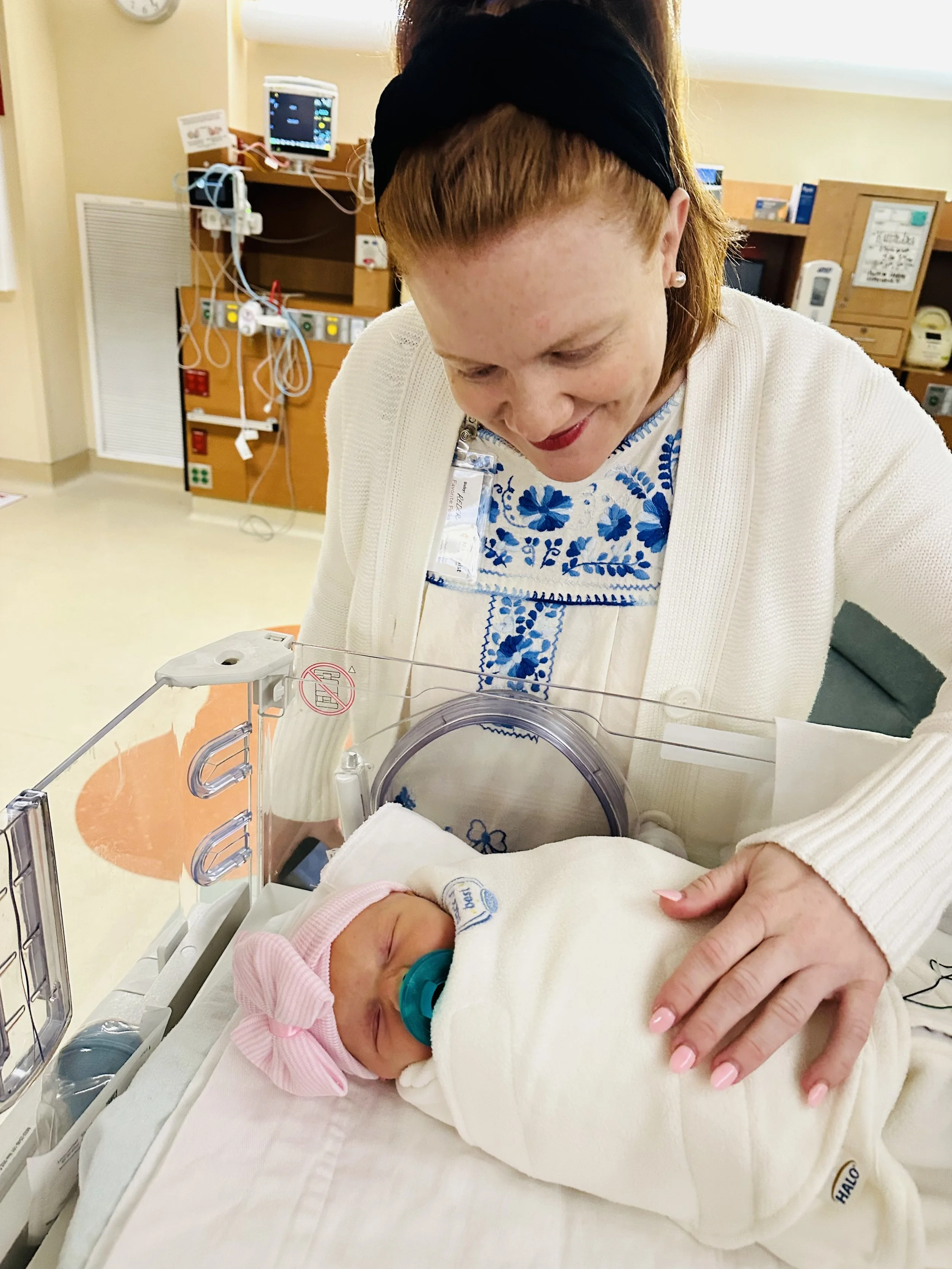
The day my doctor called and the day we went home.
✦ ✦ ✦
The First Ten Weeks: Sleep Deprivation, Postpartum Depression, and the Moon
For the first two and a half months or so of Rosie's life, I was struggling with postpartum depression. I was so severely sleep deprived that I was beginning to have debilitating anxiety and visual hallucinations. I had also left my husband for my safety while pregnant, so I was caught up in this web of grief I could not untangle. I spent so many nights looking up at the moon, and wondering where he was and wishing I weren't. Wondering what it would have been like if he had been the one carrying me from the hospital bed to the bathroom to change me, the one to cut the cord, the one to pull the car around and carry her out of the hospital. It was its own kind of madness.
It made no sense and perfect sense all at once. He and I created her together, so it did not matter how quickly the depth of my love transformed into hate. I think in my bones, those feelings were unavoidable.
So, there in the middle of the night, I let them come. No one to reach across the bed for reassurance or comfort. Just me and my girl, against the world.
Night wakings were a specific kind of lonely.
I was lucky in a way I know some women in my situation are not. I had parents willing to fill that void. Rosie went down at seven. She'd wake around eleven for a feed, then again at three. I'd get the bottle started, and my mom would come in, take over, and send me to sleep in the other room for a few hours. Sometimes my dad took the 3 a.m. shift. We came up with a system, and it worked.
✦ ✦ ✦
Shift 1: The Night Shift — Partners, Villages, and Doing It Alone
I won't tell you my story with the help edited out, but I know the question: what if there's no one down the hall?
If you have a partner, have the shift conversation, and have it before resentment forces it out of you. Split the night into blocks and protect each other's longest one completely: one of you owns eleven, the other owns three, and you can alternate nights for a third shift if needed. The off-duty parent sleeps somewhere the crying can't reach them. If there's a mother, a sister, a friend who keeps offering to help, LET THEM. Overnight help and naps are what you ask for. My mom, sister, and aunts forced me into bed and it saved me.
Casseroles are kind. Sleep is kinder.
The Solo Night Protocol:
If there is genuinely no one, here’s the shift. Your baby's longest stretch is usually the first one of the night, so some nights, go to bed when they do, even if it's 7:30. Let every other standard drop. Paper plates. Yesterday's clothes. A baby fussing for a few minutes in a safe crib while you shower with a baby monitor or lie flat is not neglect; it's maintenance on the only caregiver they have.
You do not owe anyone a visit or a clean house in exchange for a meal.
And tell your pediatrician you're doing this alone, because they can connect you to postpartum support, including Postpartum Support International's helpline, which answers the 2 a.m. version of alone.
When your brain lies to you, and tells you this self-care is selfish, remind yourself:
This is good for my baby. This is good for my baby. This is good for my baby.
No medals will be given out for mothering the hardest on the least amount of sleep.
KEY TAKEAWAY — Shift 1
With a partner: split the night into blocks and protect each other's longest one.
Off-duty parent sleeps where the crying can't reach.
Ask for overnight help and naps, not casseroles.
Solo: sleep when they sleep, drop every other standard, and tell your pediatrician you're alone.
✦ ✦ ✦
The Only Two Things I'm Strict About
I am not a rigid parent. I'm also not a gentle parent, if by gentle you mean permissive. I would describe my parenting style as consistent, responsive, and loving. Firm and fair and fun.
Not harsh. Clear.
Not rigid. Consistent.
However, there are two areas where I am much more structured: her behavior, and her sleep.
Sleep is health. Sleep is regulation. Sleep is safety.
Children thrive on structure because it gives them predictability.
We started building sleep foundations, what most people call sleep training, within the first month. Stay with me, because I know I'm about to lose about half of you since I just used the word "training" in relation to your child. Sleep training has become taboo and misunderstood. Here is what I mean by it: a consistent schedule, a consistent bedtime sequence, and a consistent, gentle response. That's it. No timers counting up to twenty minutes. No "learned helplessness." At that age, the routine worked around Rosie's feeding needs, not the other way around. We fed her when she needed to eat and followed her pediatrician's guidance on longer stretches. The goal in those early weeks was predictability, not twelve uninterrupted hours.
There's a corner of the internet that will "sleep shame" you into believing sleep training is selfish.
They've got it backwards. A rested mother isn't selfish. She's exactly what the baby needs.
I prefer science over stigma.
Prior to Rosie's sleep routine, I was watching her breathe at night, head at the foot of the bed to get as close to her bassinet as possible, to ensure the comforter did not, you know, randomly crawl into her bed in the middle of the night and suffocate her. Our maternal lizard brain does some really fun things to us postpartum, doesn't it?
So when we finally got started, I wrote down a schedule based on obsessive research. Wake windows, nap times, seven to seven. I tracked her sleep on an app, but that just felt like more work. So we switched to her Owlet and never looked back. And I stuck to it. Even when she hated it, even when I hated it. 95% of the time, we stuck to it.
Here’s some proof from a 3 month old Owlet Sock reading:
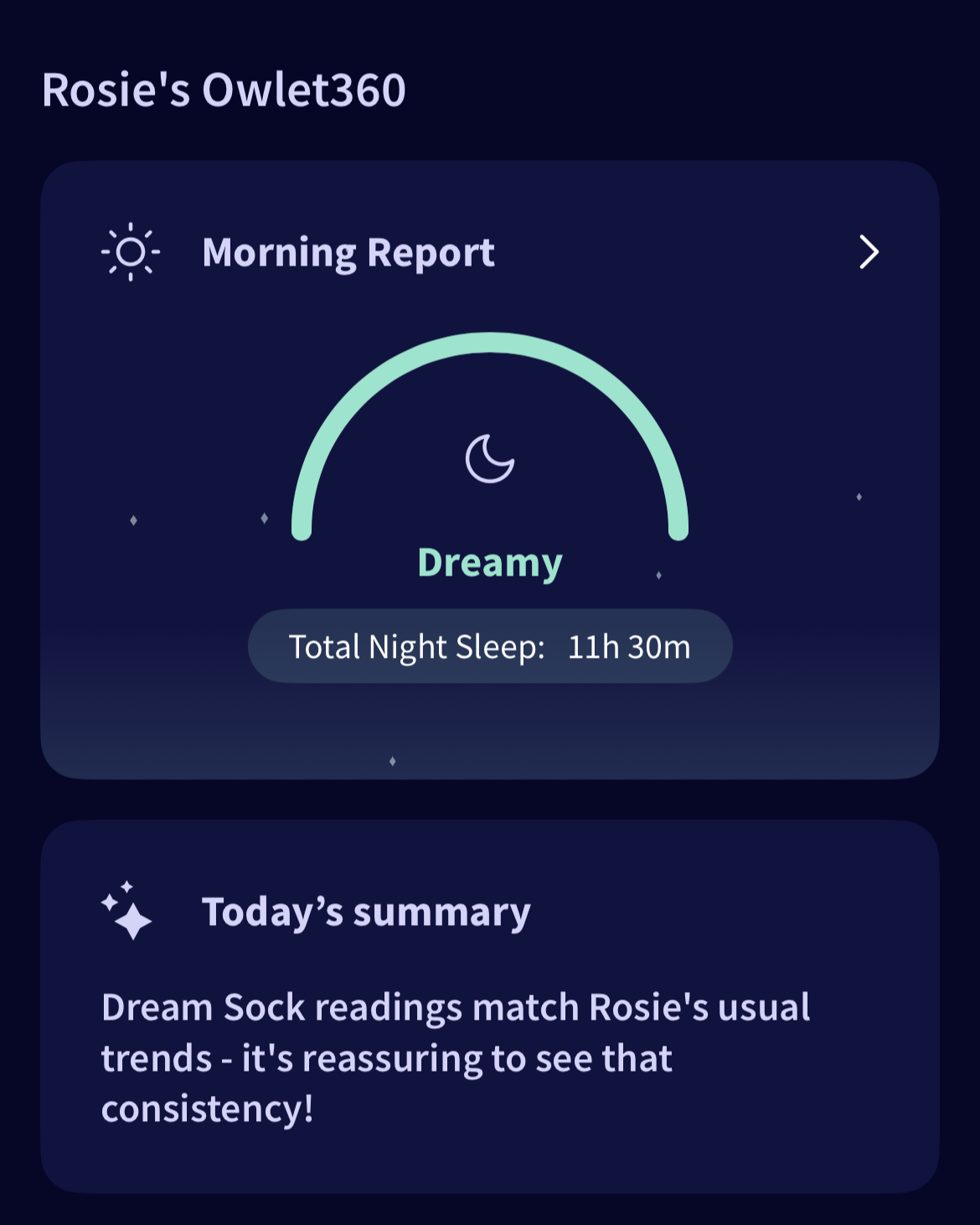
Rosie’s Owlet reading from May 1, 2025 — 3 months old.
Your mental health isn't separate from their development. That is NOT to say a struggling mother damages her child. The postpartum struggle is universal and postpartum depression is all too common. But we MUST connect sleep to mental health and maternal mental health to healthy child development. And remember that rest is one of the few levers you can actually pull.
Your sleep is part of your baby's care. That's permission to give yourself grace.
✦ ✦ ✦
Shift 2: The Bedtime Order of Operations
This became rehearsed, essentially. Every night, the same sequence, in the same order.
Bath.
Blinds closed.
Diaper.
Lotion.
Jammies.
Swaddle or sleep sack.
The same white noise, every night, from Alexa.
And then, out loud, the phrase that became her cue: "Alexa, goodnight."
Hit the lights.
That phrase was a trigger, in the Pavlovian sense. She knew: it is now time for sleep.
My behavior therapist brain was kicking in.
Then the same rocking chair, in the same spot, the same affirmations, the same songs. "Part of Your World." "Come What May." The Phil Collins song from Tarzan. I have sung "Part of Your World" every single night of Rosie's life for nineteen months. So much so that today, she can even fill in some of the words. I plan to still be singing it when she's a teenager filing for emancipation.
For naps, only ever "You Are My Sunshine," with half the blinds open so her body could tell day from night.
A randomized controlled trial by Kathryn Lee and Caryl Gay tested simple bedroom changes with new parents, and found the gains showed up among the mothers whose bedrooms were not already optimized. If the fancy bassinet is in your budget and you love it, wonderful.
However, you do not need expensive baby gear to create a sleep-friendly environment.
KEY TAKEAWAY — Shift 2
Same sequence, same order, every night: bath, blinds, lotion, jammies, swaddle, song, sound.
One spoken cue that means sleep. Ours is "Alexa, goodnight."
Same chair, same songs. Different song and open blinds for naps, so day reads as day.
You do not need expensive baby gear to create a sleep-friendly environment.
✦ ✦ ✦
Shift 3: The No Eye Contact Rule (and the Science That Convinced Me)
This one was hard for me, so I understand if it's hard for you.
The advice, which shows up constantly in sleep-consultant guidance, is no eye contact during night wakings or at bedtime. And I remember thinking: you're telling me I'm not allowed to look at my child while I rock her to sleep? Ha!
Then I watched her. She recognized eye contact as engagement, and engagement meant it wasn't time for sleep yet.
Here's what convinced me, and I want to be precise, because this is a place where the internet overstates things. Babies regulate their own stimulation. Developmental researchers going back to Tiffany Field's work in the 1980s have documented that when babies are overstimulated, they look away, and their heart rate comes down. More recent infant research using heart rate and pupil measurements has continued to tie a baby's arousal state to how they use their gaze in social moments.
So think of face-to-face engagement as an input. Rosie breaking her gaze in the middle of the night wasn't rejection. It was her nervous system asking for exactly what I was finally giving her.
Daytime is for engagement. Nighttime is for regulation.
And I didn't need to worry about losing bonding time, because I already knew my child was securely attached. We were bonding through the rocking, the singing, and me rubbing the same little spot across her eyebrows, over and over.
KEY TAKEAWAY — Shift 3
No eye contact during night wakings or at bedtime.
Eye contact reads as "we're playing." Your baby is not being difficult, you are not failing.
When they look away, they're self-regulating. Let them.
Bond through touch, rhythm, and voice instead. Daytime is for faces.
✦ ✦ ✦
Shift 4: Should You Let Your Baby Cry It Out? My Three-Minute Rule
My version was a compromise.
My mom and I would absolutely cringe when she cried, hearts hurting, looking at each other: "We should go get her, right? No, no, we should let her settle. No, we should go get her, right? No, let's just give her 3 minutes." So it became a 3-minute rule.
I never let her cry for more than three minutes. At three minutes, I went in. Quiet shushes from beside the door, not the crib. Then I'd wait three more minutes. If that didn't calm her, back in I'd go, one hand on her belly, firmly, shushing or humming. When she was calm, I left. If it started again, I graduated the comfort and rocked her back down. No eye contact. No talking. Dark room.
Each time I went back in, I picked up where the last visit left off but added a level of comfort. That was the graduation: one step further along the same path, but the initial comfort level is less intrusive, so I was giving her room to settle on her own and simultaneously reassuring her that I was right there when she needed me.
So is that "cry it out"? No. And it isn't quite the Ferber method either. What researchers call graduated extinction is the family my method belongs to: you respond, but you leave increasing room for the baby to settle. The Ferber version stretches waiting intervals to twenty or thirty minutes and asks you to pat but not pick up. I never did that. My interval stayed at three minutes. I stayed until she was calm. And if she needed to be rocked, I rocked her.
Same family, gentler house.
Any behavior therapist would tell you I was rewarding the crying. I was a behavior therapist, so I'll clear things up. Two things made this work. At ten weeks, a baby isn't crying to get something. They're crying because they can't settle yet, and they need help learning how. And I left when she was calm, every single time, so calm is what she learned.
Later, on the rare night she woke and cried, she was back asleep within, you guessed it, about three minutes.
Shift 4
The 3-Minute Rule
Both methods check on the baby. The difference is what changes each time you go back in: how long you wait, or how much comfort you give.
Ferber
The waiting growsBy the end of the week, the waits stretch to 20 or 30 minutes.
Same comfort. Longer waits.
The Three-Minute Rule
The comfort growsNever more than three minutes. No eye contact. No talking.
Same wait. More comfort.
Same family, gentler house.
Rosie Red Nest
And the question underneath it all: does any of this hurt her? The largest study I found, followed 326 families for five years and found no differences in emotional and behavioral problems, stress measured in saliva cortisol, the child-parent relationship, or attachment between families who used these techniques and families who didn't.
That's the part that let me sleep, in every sense. Attachment isn't built in fifteen minutes of frustration late at night. It's built in the other twenty-three hours and forty-five minutes, when you are feeding them and holding them close and singing the same song for the four hundredth night in a row.
KEY TAKEAWAY — Shift 4
Three minutes of crying, then go in.
Comfort until calm, then leave. Escalate only if you need to: door shush, hand, rock.
Pick up where the last visit ended instead of restarting.
No eye contact, no talking, no change to the room.
✦ ✦ ✦
Shift 5: The Rock and Stop — How to Put Your Baby Down Without Waking Them
If your baby wakes up the second you lower them into the crib, they aren't broken and neither are you. The startle reflex, what pediatricians call the Moro reflex, fires when a baby senses a sudden movement or the feeling of falling. To their body, the put-down is a fall.
My first method didn't work. I tried using the momentum of the rocker to rise out of the chair mid-sway and carry the motion to the crib. First of all, I am not that graceful, and postpartum recovery meant my body rejected any sudden vertical movement or any movement at all. I even got stuck in the recliner with Rosie for twenty minutes once, unable to reach my phone.
My escape from that chair is proof enough that moms are capable of anything.
What worked is what I call the Rock and Stop. Routine, then rock. As soon as I noticed she was getting close to drowsy, I stopped rocking. Completely still. Held her. Then rose and made the transfer.
I didn't invent the science. Researchers at Japan's RIKEN Center for Brain Science found that carrying a crying baby for about five minutes and then sitting completely still for about eight more before laying them down produced successful transfers. Skipping stillness meant a woken baby. Science said eight. In practice for me, it was about five minutes of sitting still.
The Rock and Stop is my version of their principle: motion soothes, but stillness is the bridge between your arms and the crib.
Then the put-down itself, which became a dance. I lowered Rosie onto her side and gently rolled her onto her back, keeping her head supported, one hand firm on her chest the whole way. That was the transfer that worked for us. Current AAP safe-sleep guidance recommends placing babies directly on their backs for every sleep. Then I removed my hand and backed out of the room like I was defusing a bomb.
And its origin? Not a peer reviewed journal.
TikTok.
KEY TAKEAWAY — Shift 5
Rock until drowsy, then stop completely and hold still. Five to eight minutes.
Stillness is the bridge. Skipping it is what wakes them.
Lower baby slowly with full head and body support, placing them directly on their back.
Keep a firm hand on the chest briefly, then remove your hand slowly and back out like you're defusing a bomb.
✦ ✦ ✦
These five shifts are the foundation: the what and the why.
The full Sleep for Sanity guide covers the how for the entire first year — schedules by age, nap transitions, regressions, troubleshooting, and decision trees for when to push through and when to pivot. CLICK HERE TO JOIN THE WAITLIST.
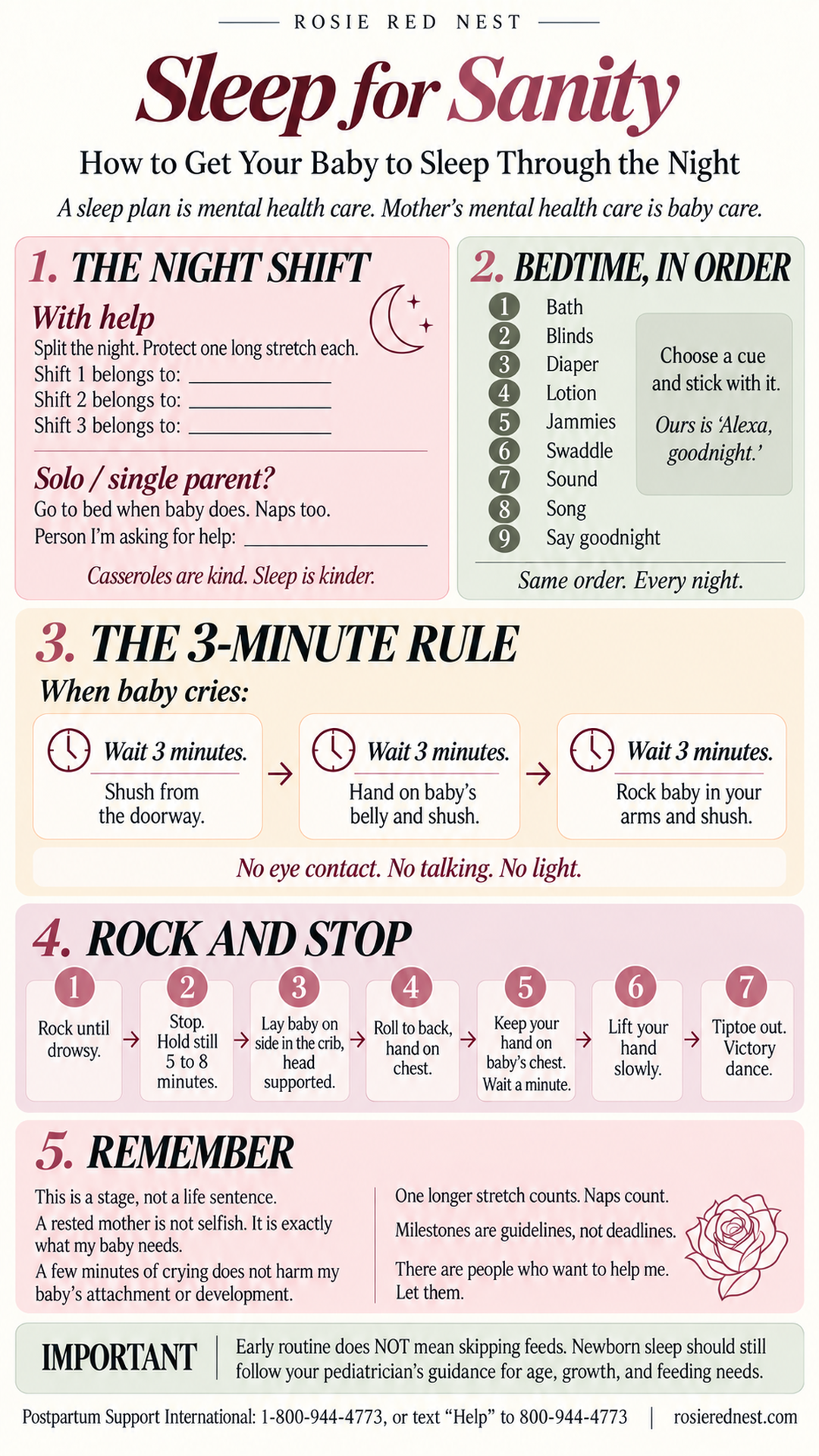
The one-page Sleep for Sanity cheat sheet:
Need the whole system at a glance?
Save the one-page cheat sheet to your phone or print it for the fridge.
No email required.
DOWNLOAD HERE:
SAVE TO PHONE
PRINT FOR FRIDGE
No email required. Five shifts, the bedtime order of operations, the Rock and Stop sequence, the 3 minute rule, all on one organized page your exhausted brain can comprehend at 3 a.m.
✦ ✦ ✦
The First Time She Slept Through the Night
It didn't happen at home.
We went to Fort Worth for an event my mom had, and Rosie slept in the hotel's little rollaway crib. I woke up in the morning, body shooting straight up out of bed, thinking something was wrong because she hadn't woken me. I ran to check. Sweet. Angel. Baby. Asleep. Eight and a half hours.
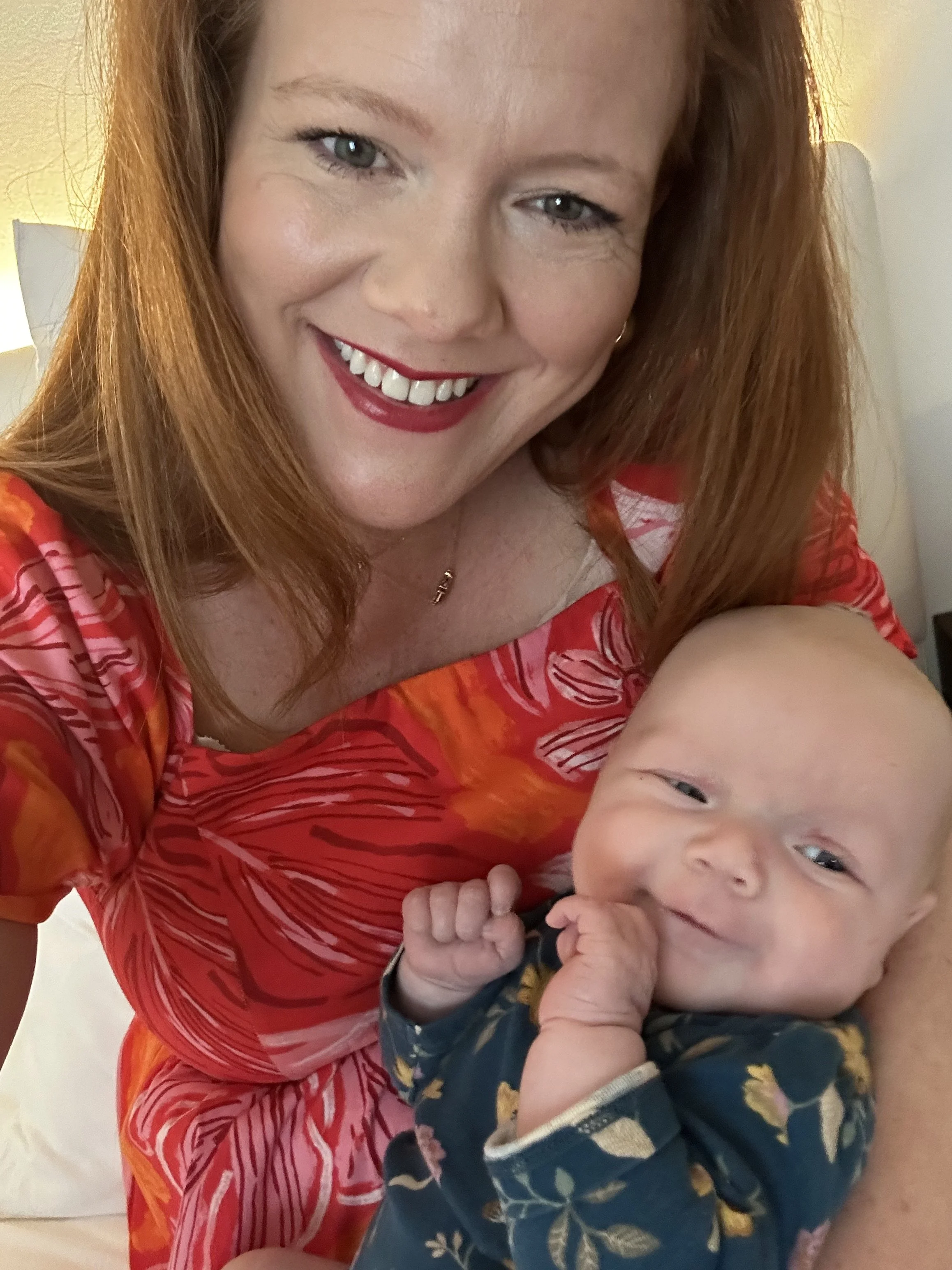
Fort Worth, TX - March 29, 2025
Eight and a half quickly turned to twelve, and twelve became our new normal. Fort Worth was proof that we had built something strong enough to survive a different environment.
Not long after Rosie started talking, she began saying "night-night" at her nap times and at bedtime. For over a year she'd gone to sleep at the same times. Up at 7. Naps at 9:30 and 2:30. Bedtime at 7. Some nights now, she snuggles into my shoulder and reaches for her crib, because she's tired and she knows what's coming next. She's listening to her own little body.
A body that knows what comes next builds a brain that isn't bracing for it.
✦ ✦ ✦
Do You Have to Co-Sleep to Bond With Your Baby?
To this day, I can count on one hand the times Rosie has slept in my bed. And to this day, I still see posts from friends and strangers about the absolute beauty of co-sleeping, and I can see it. What a wonderfully intimate way to bond with your child.
But it's not the only way. Sometimes I feel like I missed out on something, and I kind of envy the mothers who co-sleep. I chose differently because I know myself. I am a heavy sleeper. I've been known to roll over on full-grown adults, and I wasn't willing to find out what that meant for a ten-pound child. This is sleeping for my sanity and for her well-being.
While advocates of "attachment parenting" often promote bed-sharing as essential, major developmental studies show that sleep location does not dictate the quality of parent-child attachment. A landmark longitudinal study tracked mother-infant pairs from birth through 18 months and found no statistical difference in attachment between families who bed-shared and those who did not. Secure attachment is built through responsive, loving interactions during waking hours.
Where your baby sleeps is a safety decision and a household decision. It is not a love decision.
And if you do bed-share, please do it deliberately and safely, and talk to your pediatrician about it.
Choosing not to co-sleep doesn't mean I have less of a bond, or that she has a less secure attachment to me. We have to be confident enough in our own maternal instincts to not question the decisions we make for the well-being of our child. The more we trust those instincts, the more we quiet the noise, the more competent we become as new mothers.
Just as it does for our children, competence breeds confidence.
✦ ✦ ✦
Sleep Is Mental Health Care: What the Research Says
Postpartum depression affects about one in eight women with a recent live birth, according to the CDC. And the research keeps pointing at the same lever. In a randomized controlled trial published in the Journal of Sleep Research, mothers of two-to-four-month-olds were taught a gentle behavioral sleep program. The babies still woke up just as often. What changed was the length of the longest unbroken stretch: the single block of sleep a mother gets before the first waking grew by well over an hour, and the mothers got better. Sleep quality up, depression scores down. A meta-analysis published in Sleep Health found the same pattern across multiple trials. Better infant sleep, improved maternal mood.
I hope you find that as enormously comforting as I did. It means the goal was never a baby who sleeps perfectly. You are not failing a test every time your baby wakes up. You only need one longer block. That is a much smaller, much more achievable thing than the thing you have been lying awake feeling like a failure about.
This is science giving us permission to kick perfectionism out of our homes.
✦ ✦ ✦
I did not accept sleep experts' recommendations at face value. I did the research, took what I wanted, left what I didn't, maintained the structure, and trusted my instincts about what was right for my child and our life. When something stressed me out or an app felt like additional work, I removed it from my system.
And that's the part I want you to take with you. Co-sleeping, cry it out, schedules, all of it: these are deeply personal things to navigate. This is always about doing what is right for your child and what fits in your life.
Sleep should not be rocket science. We don't need 100-page guides, a 300-page book, or 5 different apps. Choose advice from real mothers, backed by research, built not to overwhelm but to help you overcome.
My number one goal here in the nest is your mental health, and solving the problems that overwhelm your life.
You grew a person and then you brought them into the world. An extraordinary act. And YOU did that. Whatever you believe about yourself in the dark, that fact doesn't change. So be kind to yourself, choose a system that is kind to you too, and go conquer that sleep monster like the force of nature you are.
And if you are the mother staring up at the moon, with your whole world in your arms, sobbing, certain it will never end: there is a place on the other side of this.
A place of rest, a place of peace, a place where you bask in the joy of the miracle you have created.
I've been to both sides now.
I'll be here when you need that reminder, because I once needed it too. 🤍
Join the waitlist for the full Sleep for Sanity guide, coming soon.
✦ ✦ ✦
Baby Sleep FAQ
When do babies sleep through the night?
Every baby is different, and mothers of four will tell you some kids are simply born sleepers and some aren't. Rosie did it at ten weeks. I had a system, help, and honestly, some luck. But I won't explain away all of my hard work by attributing it to luck, because I truly believe she was never going to sleep through the night that early had I not developed a system. Many babies get there between three and six months. If yours hasn't, you are not behind. And when regressions come — because they will — you rebuild on the same foundation.
Milestones are guidelines, not deadlines.
But if you are genuinely concerned, always ask your pediatrician.
How long should you let a baby cry?
A five-year follow-up published in Pediatrics found no lasting differences in attachment, behavior, stress, or the parent-child relationship between families who used gentle behavioral sleep methods and families who didn't. The research draws a clear line: structured methods with consistent check-ins show no evidence of harm. Leaving a baby to cry for hours without response is a different category entirely, and if you're there, talk to your pediatrician. I can only tell you what I did: never more than three minutes, followed by comfort, then retreating to let her body learn to fall back asleep on its own.
What time should a baby go to bed?
We did 7 to 7 from early on, but the right bedtime is the one that works for your family. Some do 6 to 6, some do 8 to 8. An earlier bedtime tends to produce more sleep, not less, which sounds backwards until you've watched an overtired baby fight sleep at nine at night. But keep family schedules in mind. Consistency matters most.
When should you start a bedtime routine?
We started within the first month. Not day one. You're allowed to spend the first days surviving and learning your child. Let your body and brain heal in that first month, then implement a system. The plan you can stick to is always the best choice.
✦ ✦ ✦
Sources & Research
Lee, K.A. & Gay, C.L. (2011). Bedroom environment changes and new parent sleep. PubMed
Price, A.M.H. et al. (2012). Five-year follow-up of behavioral infant sleep intervention. Pediatrics
Ohmura, N. et al. (2022). Transport response method for soothing crying infants. Current Biology
Rouzafzoon, M. et al. (2021). Infant sleep interventions and maternal sleep and mood. Journal of Sleep Research
Bilgin, A. & Wolke, D. (2022). Bed-sharing and infant-mother attachment at 18 months. PubMed
Field, T. (1981). Infant gaze aversion and heart rate during face-to-face interactions. ScienceDirect
CDC. Symptoms of depression among women with a recent live birth. CDC
